
Corporate Tax in Europe: A Comparative Study for Foreign Founders

Every "best countries for low tax" list ranks Europe by headline corporate rate and calls it a day. That's close to useless for a foreign founder, because the headline rate is rarely the number that actually determines what you pay. Ireland's famous 12.5% only applies to trading income; passive income is taxed at 25%. Estonia's system doesn't really have an annual "rate" at all in the conventional sense; it has a trigger. Georgia's 15% is seldom the number an early-stage founder actually pays.
This is a genuine, mechanism-level comparison of six European markets eMooves covers, not a ranked list, but an explanation of how each system actually works, because the structure of the tax matters more than the number attached to it.
United Kingdom: A Straightforward System With a Real Small-Business Break
The UK runs a conventional annual profits tax, currently at 25% as the main rate, applied to companies earning over £250,000 in profit. Below £50,000 in profit, a 19% small profits rate applies. Between those two thresholds, marginal relief tapers the rate gradually rather than creating a cliff-edge; therefore, a company earning £100,000 in profit pays somewhere between 19% and 25%, not a flat 25% the moment it crosses £50,000.
There's no separate "startup" regime layered on top of this; the small profits rate is the startup relief, and it's automatic, not something you apply for. Corporation tax is filed annually via CT600, due within 12 months of your accounting period ending, with payment due 9 months and 1 day after that period ends.
The practical takeaway: the UK's system is the most conventional of the six, easy to model, easy to forecast, no reinvestment games to play. What it doesn't offer is any structural incentive to retain profit in the company rather than distributing it; tax is due on profit as earned, whether you keep it or pay it out.
Estonia: There Isn't Really a "Rate"; There's a Trigger
Estonia's system is the one most founders get wrong, because it doesn't map onto the "annual profits tax" mental model at all. Under Estonia's distributed-profit model:
- Retained and reinvested profit is taxed at 0% indefinitely, for as long as it stays in the company. There's no annual return calculating a rate against retained earnings, because none is owed.
- Tax is triggered only at distribution when profit leaves the company as dividends; it's taxed at 22% (calculated as 22/78 of the net distribution), a rate that increased from 20% at the start of 2025.
- A newer development to know: from 2026 through 2028, Estonian companies must additionally pay a 2% "security tax" on the previous year's profit, charged quarterly, a change that applies regardless of whether that profit was distributed or retained, so it sits slightly outside the pure distributed-profit logic and is worth budgeting for separately.
The practical takeaway: Estonia isn't "low tax" in the way Ireland or Georgia are; it's deferred tax. A company that reinvests every euro of profit for five years pays zero corporate tax across that period. A company that distributes profit annually pays a real 22% on each distribution, not meaningfully lower than the UK's main rate. The entire value of Estonia's system is the timing flexibility, not a permanently lower rate.
Portugal: A Falling Headline Rate, With Meaningful Regional and Startup Variation
Portugal's mainland standard rate is 19% in 2026, down from 20% in 2025 and 21% before that, and it's scheduled to keep falling, to 18% in 2027 and 17% in 2028 under a law passed in November 2025.
On top of the falling headline rate, Portugal layers real SME and startup relief:
- 15% on the first €50,000 of taxable income for qualifying SMEs and Small Mid-Cap companies, with the standard rate applying above that threshold.
- 12.5% on the first €50,000 specifically for certified startups (under Law 21/2023) operating with effective management in Portugal's inland territories, a meaningfully lower rate than even the general SME relief, aimed specifically at drawing business away from the Lisbon/Porto corridor.
- Madeira and the Azores run their own reduced regime at 13.3%, a flat 30% reduction off the mainland standard rate, available to companies genuinely headquartered and managed there.
Two things worth flagging that most comparison content skips: Portugal layers municipal surtax (up to 1.5%) and, for larger companies, a state surtax (3% between €1.5M–€7.5M profit, 5% between €7.5M–€35M, 9% above €35M) on top of the headline CIT rate, meaning the effective rate for a large, established company sits noticeably above the 19% headline. And Portugal offers a 10% deduction for retained and reinvested profits, up to €12 million, a genuine, if partial, echo of the Estonian logic, layered onto an otherwise conventional annual system.
The practical takeaway: Portugal rewards being small, being new, and being outside the capital, three conditions a genuine early-stage foreign founder often already meets, making the effective rate considerably better than the headline number suggests for the right kind of company.
Spain: The Most Layered SME System of the Six
Spain's standard rate is 25%, but almost no early-stage company actually pays it, because Spain runs one of the most granularly tiered systems in Europe:
- 23% applies to companies with turnover under €10 million, a transitional 2026 rate on a path down to 20% by 2029.
- Micro-enterprises (turnover under €1 million) get a bracketed rate: 19% on the first €50,000 of taxable income, 21% on the excess.
- Newly created companies get 15% for their first two profitable tax periods, a general relief available to most new incorporations, not conditional on being classified as a "startup."
- Certified startups under Spain's Startup Law (Ley 28/2022) get the same 15% rate for longer, the first profitable period plus the following three, meaning up to four years at 15% rather than two, provided the company continues to meet the law's qualifying conditions (newly formed or incorporated within the last 5 years, or 7 for biotech/energy/industrial sectors; not formed via merger or spin-off from a non-qualifying entity; hasn't distributed dividends).
This creates a genuinely important distinction most generic guides collapse into one number: a standard newly incorporated Spanish company gets 15% for 2 years; a certified innovative startup can get 15% for up to 4 years. Confirming which category you actually qualify for and applying for certified startup status, specifically if you're eligible, is worth real money over the relief period.
The practical takeaway: Spain's system is the most administratively layered of the six, which cuts both ways, genuinely generous for the right early-stage profile, but the eligibility rules (particularly the "hasn't arisen from a merger or spin-off" and workforce-location conditions for startup status) need careful checking rather than assumption.
Ireland: One of Europe's Lowest Headline Rates, With a Sharp Trading/Passive Split
Ireland's 12.5% rate is the one every founder already knows about, and it's real, but it applies specifically to trading income, meaning income from the active conduct of a business. Passive income, rental income, most investment income, and income from non-trading activities are taxed at 25%, a rate most comparison content omits.
For genuinely large groups, Ireland has implemented the OECD's Pillar Two global minimum tax: multinational groups with consolidated revenue exceeding €750 million must pay a minimum effective rate of 15% through a Qualified Domestic Minimum Top-Up Tax. This has zero bearing on the overwhelming majority of foreign-founder-led companies, whose revenue sits nowhere near that threshold; it's worth knowing the 12.5% headline isn't unconditionally available to any company anymore.
The practical takeaway: Ireland's rate is genuinely as good as its reputation for an active trading business, but a founder planning to hold investments, IP licensing income, or property through an Irish entity needs to check which side of the trading/passive line that income actually falls on, since the gap between 12.5% and 25% is the largest single rate differential of any country in this comparison.
Georgia: The Deepest Reinvestment Incentive, Plus a Sector-Specific Zero Rate
Georgia runs the same fundamental logic as Estonia, the Estonian model, adopted in 2017, but pushes it further with sector-specific overlays that don't exist in the Baltic original:
- Standard CIT is 15%, applied only to distributed profit. Retained and reinvested earnings are taxed at 0%, with no separate additional tax layered on top of the way Estonia's 2026–2028 security tax does.
- Virtual Zone Person status gives qualifying IT companies 0% corporate tax on income from exporting digital services and software to foreign clients; the exemption applies specifically to non-resident client revenue; income from Georgian clients reverts to the standard 15% rate. Distributions from a Virtual Zone company still carry a 5% dividend tax, which Georgia's network of 55+ double tax treaties can often reduce to 0%.
- Small Business Status offers individual entrepreneurs (not LLCs) a 1% tax on gross turnover, with no expense deductions, available up to GEL 500,000 (roughly $185,000) in annual turnover, a mechanism aimed at solo consultants and freelancers rather than scaling companies, but genuinely useful for a founder testing a services business before incorporating formally.
- VAT registration only becomes mandatory above GEL 100,000 (roughly $37,000) in turnover, a considerably lower bar than the EU markets in this comparison, worth factoring into early cash flow planning.
The practical takeaway: for a founder running an IT/software export business specifically, Georgia's combination of Virtual Zone 0% CIT plus 0% retained-earnings treatment is arguably the most aggressive legitimate structure in this entire comparison, but it's genuinely sector-conditional, and companies serving the local Georgian market get none of these benefits, reverting to the standard 15% distributed-profit model.
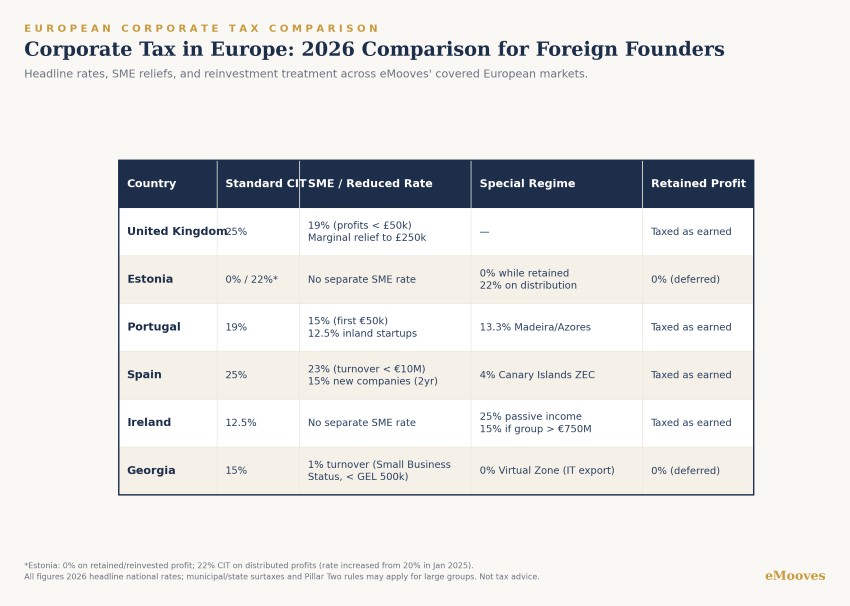
The Comparison Table
The table above summarises headline rates, SME reliefs, and reinvestment treatment side by side. Download it directly for reference, or read the breakdowns above for the mechanism behind each number.
The Pattern Across All Six
Two structural splits explain almost everything in this comparison, and they matter more than any single rate:
Distributed-profit systems (Estonia, Georgia) vs. conventional annual systems (UK, Portugal, Spain, Ireland). The first group rewards patience, reinvestment, and deferred tax indefinitely. The second group taxes profit as it's earned, regardless of what you do with it, but often compensates with SME reliefs on the first tranche of profit. Neither structure is objectively better; it depends entirely on whether your business model is retain-and-scale or extract-and-distribute.
Sector- and size-conditional relief is where the real money sits. Every country in this comparison except the UK layers a meaningfully lower rate onto a specific founder profile, Portugal's inland startups, Spain's certified emerging companies, Georgia's IT exporters, and Ireland's trading (not passive) income. The headline national rate is largely irrelevant to founders who fit one of these categories; it's the fallback rate for everyone else.
Common Mistakes Foreign Founders Make
- Comparing headline rates without checking what they actually apply to. Ireland's 12.5% vs Georgia's 15% looks like a simple comparison until you realise one is a flat annual rate and the other is a distribution trigger with a 0% floor while retained.
- Assuming Estonia and Georgia's 0% retained-profit treatment means "no tax, ever." It means deferred, not eliminated, the moment profit is distributed, both jurisdictions charge a real rate (22% and 15%/5% respectively) that isn't dramatically below conventional systems.
- Missing sector or size conditions on the lowest available rates. Georgia's 0% Virtual Zone rate, Portugal's 12.5% inland startup rate, and Spain's extended 15% certified-startup rate are each conditional on specific, verifiable criteria and are not automatically available to any newly formed company in that country.
- Ignoring surtaxes and top-up mechanisms that apply above the headline rate. Portugal's state surtax and Ireland's Pillar Two top-up tax only bite at higher profit levels, but a founder planning for scale should model them in from the start rather than being surprised later.
There's no single "best" country in this comparison; there's a best country for a specific business model. A software company selling exclusively to non-Georgian clients gets a materially different answer than a services company serving the local Tbilisi market, even though both are incorporated in the same country. A founder planning to reinvest every euro of profit for three years gets a different answer in Estonia than a founder planning to distribute dividends annually, even though both are looking at the same 22% headline distribution rate.
Match the tax structure to your actual business model, reinvestment plans, revenue geography, and distribution timeline before matching it to the lowest number on a list. That match is where the real savings live, and it's exactly the layer most "lowest corporate tax in Europe" content skips entirely.