
UK Making Tax Digital: What It Is, Who Must Comply, and What It Means for Foreign Founders

If you're a founder with any personal financial footprint in the UK, a rental flat, a bit of consulting income, or a Self-Assessment filing, you've probably seen the term "Making Tax Digital" floating around. Here's what it actually means, who it applies to, and whether you need to worry about it.
What Is Making Tax Digital?
Making Tax Digital (MTD) is HMRC's long-term programme to move the UK away from paper-based and annual tax reporting toward mandatory digital record-keeping and quarterly submissions. It's already in force for VAT, and from 6 April 2026, it began rolling out for Income Tax too.
In practical terms, MTD means you must:
- Keep business and property records digitally, using HMRC-compatible software
- Submit quarterly updates of income and expenses
- File a final end-of-year submission in place of the traditional Self-Assessment return
Rather than filing one big tax return once a year, taxpayers in scope will now report to HMRC continuously, in digital format.
Who Must Use MTD for Income Tax
MTD for Income Tax applies to individuals, not companies. Specifically, it applies to people with:
- UK trading income (sole traders), and/or
- UK property income (landlords)
Whether you're required to join and when depends on your combined gross income from these sources:
|
Threshold |
Mandatory from |
|
£50,000+ |
6 April 2026 |
|
£30,000+ |
6 April 2027 |
|
£20,000+ |
6 April 2028 |
One important detail: this includes UK property income even if the owner lives abroad. Living outside the UK doesn't automatically take you out of scope.
Who Doesn't Need to Comply Yet, or At All
Not everyone is caught by MTD. You're outside its scope if you:
- Don't have a National Insurance Number (you can't sign up for MTD without one)
- Operate through a partnership (a start date hasn't been confirmed yet)
- Fall below the relevant income threshold
- Have been granted an exemption, for example, due to digital exclusion, disability, age, or living somewhere too remote to reasonably comply
Are Foreign Founders Impacted?
Yes, but only if you have UK-taxable income as an individual, not simply because you're connected to a UK business.
You're impacted if you:
- Own a UK rental property generating income above the relevant threshold
- Run a UK sole-trade business personally (consulting, freelancing, etc.)
- File a UK Self-Assessment return that includes SA109 residence pages
You're not impacted if you:
- Only own or run a UK limited company; MTD for Income Tax doesn't apply to companies
- Have no UK personal taxable income
- Are simply a director or shareholder of a UK company, corporate tax obligations are separate and unaffected by this rollout
This distinction matters a lot. Many foreign founders operate exclusively through a UK limited company and have no personal UK tax footprint at all; for them, MTD is simply not relevant.
A Special Rule for Non-UK Residents
HMRC has granted a one-year deferral for anyone who files the SA109 residence or remittance pages as part of their Self-Assessment.
In practice, this means: even if your income is above £50,000, you won't need to join MTD until April 2027 at the earliest.
This deferral covers:
- Non-UK residents with UK rental income
- UK residents claiming split-year treatment
- Individuals claiming treaty relief
- Former remittance-basis users transitioning to the new FIG (Foreign Income and Gains) rules
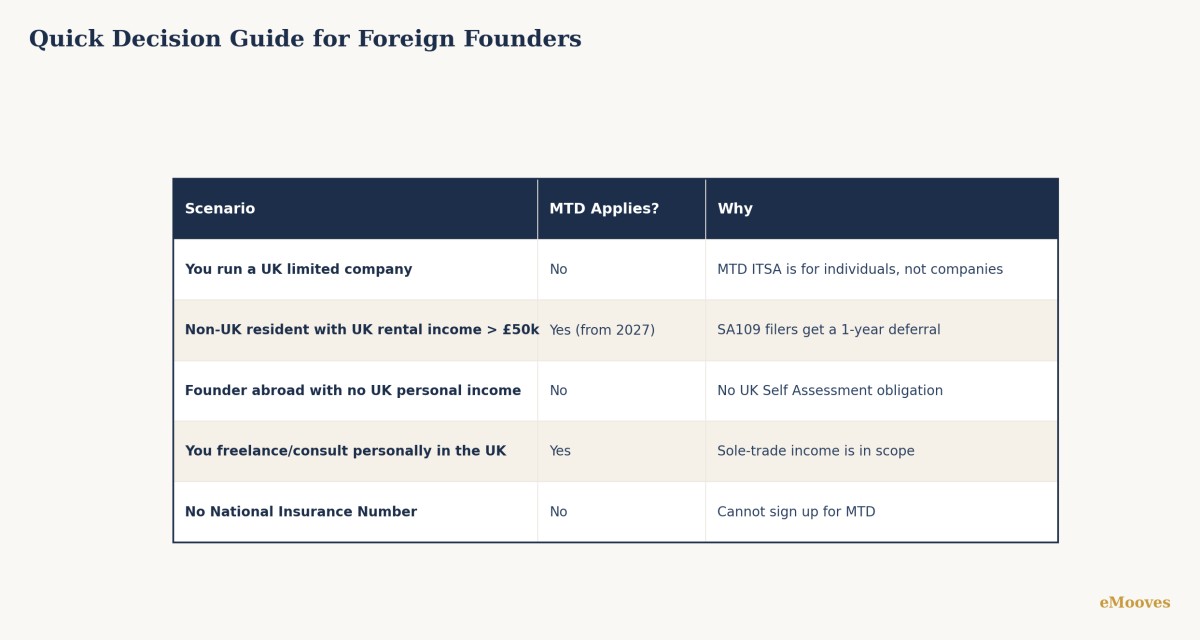
MTD is a compliance shift, not a new tax, but it does change how and how often certain people need to report to HMRC. For most foreign founders operating solely through a UK limited company, this rollout changes nothing. The people who need to pay closer attention are those with personal UK income: landlords, sole traders, and anyone filing a Self-Assessment return with UK-source earnings.
If you're unsure which category you fall into, it's worth a conversation with your accountant before the 2026 threshold catches you off guard.